Published February 20, 2026 • Steven Benner
Understanding Viking (4). Carbon Fixation on Mars and Its Interpretation
Where we left the story last, Norm Horowitz, Jerry Hubbard, and George Hobby had just run the “HHH” experiment on Mars in 1976, hoping to detect the fixation of inorganic carbon (14CO2 and/or 14CO) by Martian soils to give 14C-labeled higher organics. Again, their biological thinking was unimpeachable.
• All life requires “higher” organic molecules, molecules containing carbon atoms with C-C and C-H bonds, as well as many others.
• CO2 and CO are the predominant sources of carbon in the Mars near-surface environment.
• Thus, if Mars life exists at the Viking sites where near-surface soil was sampled, it must have a way to make higher organics from CO2 and/or CO.
• This carbon fixation could be quantified by replacing the CO2 and CO found in the Martian atmosphere by radioactively 14C-labeled 14CO2 and 14CO, and looking for formation of 14C-labeled higher organics in the soil
Now, as we noted, very few non-biological processes convert 14CO2 and/or 14CO into compounds that contain C-C bonds, and even fewer that contain C-H bonds. Thus, there were no obvious ways to get false positives by actual carbon fixation.
However, as noted in the first Single Scoop, the HHH team had noted the potential for a false positive that did not involve C-Cor C-H bond formation. If the soil was alkaline, then 14CO2 would be absorbed into the soil as bicarbonate or carbonate salts. Unless a way was found to distinguish between radioactivity bound in the soil as carbonates from radioactivity in the soil made by conversion of 14CO2 and/or 14CO into compounds that contain C-C and C-H bonds, observation of immobilized 14C-label per se could have a non-biological interpretation as well as a biological interpretation.
The workflow included a Step 5, where the soil sample was heated to 120 °C to flush out the excess radioactive 14CO2 and 14CO gas. It was not clear whether that 120 °C temperature was chosen to release the 14CO2 that had not been converted into compounds that contain C-C and C-H bonds, but remaining adhered to the soil as carbonates and bicarbonates. However, I cannot actually find a clear statement from the HHH team saying exactly why the radioactive gasses were flushed from the soil at 120 °C.
Unfortunately, the simplest analysis had a complication. It is difficult to count 14C-label in the soil, because the soil can absorb many of the electrons (beta particles) released by the decay of 14C-atoms before a detector might have a chance of seeing them.
This led to a somewhat complex workflow in the HHH experiment that required heating the soil to 635 °C, after uninterestingly bound label had been flushed out of the system at 120 °C. That heating, or “pyrolysis”, was assumed to fragment higher organics into smaller, volatile, organic fragments.
Sort of like what happens when you heat popcorn too long. The higher organics in the corn and butter get fragmented, and you can smell the organic fragments.
The workflow then relied on something called “diatomaceous earth” (brand name Chromosorb-P®) to capture those organic fragments for later processing.
Now, the HHH team knew from experiments on Earth that some of the 14C-label in the higher organics would be converted not to organic fragments that would be captured on the Chromosorb-P®, but to 14CO2, where the oxygen came from other places in the soil. This part of the fixed organics would pass through the Chromosorb-P® (Fig. 1).
As the HHH experiment was designed, that would be counted also, as “Peak 1”. “Peak 2” would be the 14CO2 from the organic fragments captured by Chromosorb-P® after those fragments had been oxidized by copper oxide embedded in the Chromosorb-P®.
However, the HHH team had identified in Earth-based pre-experiments a good source of false negative results. Some of the soils from the Atacama Desert (northern Chile) contained nitrates. When the higher organics were heated with nitrates to 635 °C, they were not pyrolyzed. They were combusted. They were set on fire. Thus, 14CO2 in Peak 1 should also be included in the calculation of the amount of total carbon fixation in soil samples.
The HHH team did not see this as a serious problem. They remarked that even though a substantial amount of the bio-organic material in the Atacama Desert had been combusted, enough had not been combusted to still allow material to be captured on Chromosorb-P®. At no point in their written text can I find a passage where they realized that if the nitrate amounts were higher, then all of the bio-organic material would have been combusted.
Nor can I find a passage where the HHH team considered the possibility that carbonate- and bicarbonate-absorbed 14CO2 might not be flushed out at 120 °C. The HHH experimental design did not manage the possibility that carbonate- and bicarbonate-absorbed 14CO2 might survive in the soils long enough to be confused in Peak 1 with 14CO2 emerging from the organic fragments bio-organic material.
These issues became relevant in 2009. In that year, the Phoenix Lander in the Martian Arctic found perchlorate (ClO4–) in Martian soils (Hecht et al., 2009). Perchlorate was not present in small amounts. It was 0.4 to 0.6 weight percent of the soil. Perchlorate was also present in some samples of Atacama coil, but only 0.03 weight percent.
Now, perchlorate is not nitrate. However, like nitrate, perchlorate does nothing to higher organics at low temperatures. However, when heated with organics, perchlorate sets them on fire. The principal product is CO2, with a percent or two of CH3Cl and CH2Cl2, depending on the precise structure of the organics being oxidized. CH2Cl2 is known to absorb on Chromosorb-P®. CH3Clis not known to absorb on Chromosorb-P®, but I expect that it does.
In 1976, the HHH team did not mention Peak 1 nitrate-mediated oxidation of higher organics as a source of the 14CO2. Here is how they report their observations on the surface of Mars (Horowitz et al., 1977):
“The lamp is then turned off, and the chamber is brought to 120 °C while the radioactive atmosphere is vented [Step 5 in the workflow]. The chamber is next heated to 635 °C to pyrolyze organic matter in the sample [Step 6]. The volatile products, together with a large amount of 14CO2 and 14CO desorbed from the soil grains and walls of the chamber, are swept by a stream of He into a column packed with a mixture of 25% cupric oxide and 75% Chromosorb-P [Step 7]. The column, which operates at 120 °C, retains organic molecules larger than methane but allows all but a small fraction of the CO2 and CO to pass into a radiation counter where their radioactivity is measured. This count is referred to as peak 1.”
It turns out that the amount of radioactivity in Peak 1 was 100 times more than the amount of radioactivity in Peak 2. Notice the phrase in italics. The HHH team assumed that the peak 1 14CO2 had been absorbed on to the “soil grains and walls of the chamber”. They did not consider the possibility that the peak 1 14CO2 came from higher fixed organics that had gotten oxygen from other species in the soil. The HHH team continued:
“The [Chromosorb-P] column temperature is then raised to 640 °C [Step 8], the high temperature causing the release of organic compounds and their oxidation to CO2 by the CuO in the column. The radioactivity of this gas is peak 2: it represents organic matter synthesized from 14CO or 14CO2 during the [photosynthetic] incubation. Peak 2 also contains the small fraction of CO and 14CO2 which failed to elute with peak 1, presumably because of the presence of some high-affinity sites in the [Chromosorb-P] column. The radioactivity of this fraction, referred to as peak 2(0), must be subtracted from peak 2 in order to estimate the amount of C fixed in organic matter.”
The HHH team evidently did not consider the possibility that both Peak 1 and Peak 2 radioactivity had come from bio-fixed bio-organics. They evidently did not consider the possibility that the Martian soils, like the Atacama soils, contained nitrate, perhaps more of it than the Atacama soils.
And they did not think of perchlorate. That was not discovered until 2009.
As we shall see in the next set of single scoops when we discuss gas chromatography-mass spectrometry results, separate experiment that heated the Martian soil without adding any 14CO2 or 14COsaw the evolution of CO2, CH3Cl, and CH2Cl2. That is, it detected the perchlorate oxidation of organics in the Martian soil.
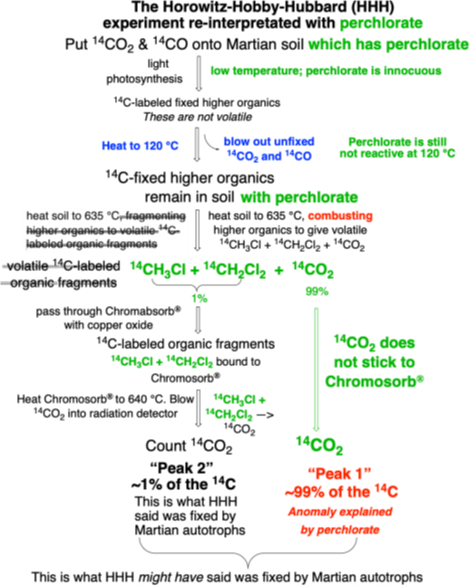
Figure 1. With perchlorate in the Viking soils, an alternative interpretation is possible for the HHH experiment. Here, the analysis recognizes that excess perchlorate burns higher organics to give 14CO2 (which does not stick to Chromosorb-P®) and CH3Cl and CH2Cl2 (which does stick). Thus, the amount of 14C fixed by Martian soil autotrophs might be represented by the sum of radioactivity in Peak 1 and Peak 2.
Figure 1 shows a re-do of the Figure 1 in the previous Single Scoop considering the presence of perchlorate in the soil. We can now go back to the numbers. If Peak 2 is seen to be the only material representing fixed organic molecules, the HHH experiment found that about 30 picomoles of carbon is fixed, that is 3 x 10-11 moles of carbon. As I noted in an earlier scoop, an E. coli cell has 1 x 10-14 moles of carbon. So if interpreted as the HHH team did in 1976, the Martian soil fixed enough carbon for 3000 cells. That is quite a bit, similar to the number of microbes in hyper-arid soils on Earth.
But if the radioactivity in Peak 2 is also seen as arising from fixed organics, here by perchlorate combustion, then the Martian soil samples fixed enough carbon for ~300,000 cells.
That is quite a biosphere.
But you see the problem. Yes, in the run-up to the Viking launch, the HHH team had identified the potential for a false positive, the bicarbonate and carbonate non-biological absorption of 14CO2 with sufficient affinity to not be flushed out at 120 °C. Perhaps their thought was to see Peak 1 as the result of this non-biological background. In any case, that is how they interpreted Peak 1 in 1976 on Mars.
But this runs afoul of the false negative that the HHH team had clearly understood in their pre-flight work. In 1970, the HHH team understood that if nitrate were present in the Martian soils, as it was in the Atacama soils, some of the Peak 1 radioactivity could also come from fixed organics. Indeed, if nitrate were in excess over organcis, then all of the Peak 1 radioactility represented autotrophic fixation.
And, of course, no one evidently considered the possibility of large amounts of perchlorate in the soil that would not fragment the higher organics, but would convert them into 14CO2, with CH3Cl and CH2Cl2. The last two would be the combustion products that were absorbed on Chromosorb-P®.
Of course, the false negative could be managed by counting the radioactivity in Peak 1 as part of biological carbon fixation. But not if the false positive problem is lurking.
Carbon was Evidently Fixed on Mars
This allows us to consider interpretations at the extremes of possibility space. If nitrate, perchlorate, and all other oxidants were entirely absent from the Martian soil, the HHH 1976 interpretation would be correct. The only radioactivity representing carbon fixation was found in Peak 1, enough for a few thousand (Terran) cells. All of Peak 2 was thus 14CO2 that was non-biologically fixed on alkaline soils as bicarbonate or carbonate salts, and not flushed out at 120 °C. These bicarbonates/carbonates released their radioactivity at 635 °C.
At the other extreme, if perchlorate or another oxidant were present in excess over fixed organics, then Peak 2 represents chlorinated combustion products arising from the reaction of higher organics with perchlorate. These can be directly attributed to higher organics, as they were in the HHH 1976 interpretation, although with an interpretation different from the 1976 HHH interpretation.
However, we cannot a priori determine the fraction of the radioactivity in Peak 2 to attribute to perchlorate combustion of higher organics, and which to attribute to non-biological absorption of 14CO2. Now, if we knew the ratio of CO2:CH3Cl:CH2Cl2 for bio-organic molecules burned by perchlorate in general, we might estimate the portion of Peak 1 14CO2 that came from fixed bio-organics and bicarbonate/carbonate inorganics. But we do not know this ratio.
That is sufficient introduction to the next Single Scoop. This sets up the next Single Scoop: what experiments are needed on Earth and in future missions to Mars, to understand the extent of carbon fixation in Martian soils, what fraction of that are to be ascribed to biological processes, and what fraction should be ascribed to non-biological processes.
References
Hecht MH, Kounaves SP, Quinn RC, et al. Detection of perchlorate and the soluble chemistry of martian soil at the Phoenix lander site. Science 2009; 325(5936):64-67; doi: 10.1126/
science.1172466
Horowitz, N. H., Hobby, G. L., & Hubbard, J. S. (1977). Viking on Mars: the carbon assimilation experiments. Journal of Geophysical Research, 82(28), 4659-4662
Posted with minor revisions by Jan Spacek 2/20/2026.
About the author
Steven Benner
Steven has developed the fields of paleogenetics, evolutionary bioinformatics, astrobiology and synthetic biology, working at Harvard, the ETH Zurich, and the University of Florida before establishing the Foundation for Applied Molecular Evolution (Alachua) and Firebird Biomolecular Sciences LLC.. His synthetic biology has had over $1.3 billion in medical applications, and is currently used in coronavirus detection. His laboratory has also resurrected 3 billion year old proteins in Jurassic Park experiments, and helped define how life may have arisen on Earth and Mars. Outside of science, Steven bicycled across the North American continent, 6083 kilometers in all. He earned a Bachelors and Masters Degrees in Molecular Biophysics and Biochemistry (Yale), and a Ph.D. in Chemistry (Harvard)
Originally posted on primordialscoop.org.