Mars science: accessible for all
Preparing for crewed missions and the search for life on Mars, at the scale the future demands.
IMPRESS is a mission architecture in which a swarm of small planetary penetrators use the kinetic energy of descent to bury into the Martian shallow subsurface and conduct in-situ science experiments, prospect for resources, and screen for risks prior to upcoming missions. Inexpensive penetrator technology will open Mars science to researchers and companies worldwide before sample return and crewed missions arrive.
For a complete mission description, read the IMPRESS white paper.



Why now
Mars exploration is moving rapidly toward sample return and, eventually, crewed surface missions. Nevertheless, the question of whether Mars hosts extant life, life that exists there today, remains unresolved. Recent reinterpretations of the 1976 Viking results, the discovery of long-chain alkanes in Gale crater, and the identification of redox-driven mineral and organic associations in Jezero crater have made past and present-day Martian habitability a significant scientific possibility worth considering in advance.
If life exists on Mars, finding it later rather than sooner creates serious issues. For example, sample returns will lack geographical context if taken from a single area and risk backward contamination of Earth with potentially harmful foreign organisms. More significantly, crewed missions would be designed without knowing what they might encounter; the same backward contamination risk could leave astronauts stranded on Mars, struggling to validate that the life they find is safe before they can return home. Finally, early human activity on Mars could alter the very environments scientists most need to study.
The current strategy of infrequent, multi-billion-dollar missions investigating one or two sites was not designed for this problem. If extant life on Mars is patchy and tied to localized microenvironments, as the mainstream view now holds, negative results from a single site cannot be extrapolated to the planet as a whole. Surveying for a sparse life target at the resolution of one rover per decade is not a strategy that can resolve the question on the timescale that sample return and crewed exploration demand.
The IMPRESS approach
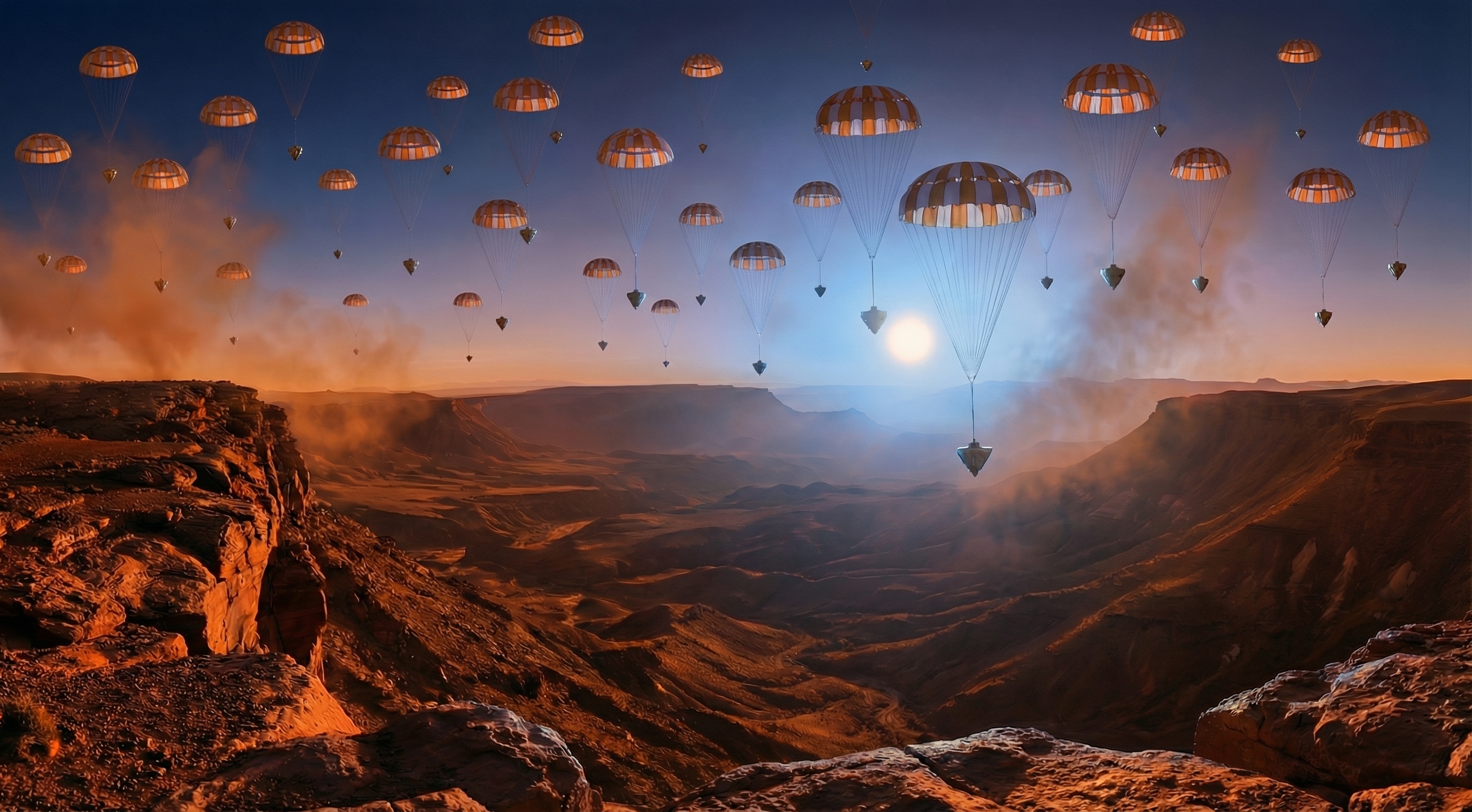
Instead of concentrating capability in a large landed system, IMPRESS will distribute small penetrator probes across the Martian surface. Each probe uses the kinetic energy of its descent to emplace a forebody 0.2-1 m into the regolith (no powered landing or powered drilling), while a tethered aftbody remains at the surface to supply power and communicate with orbiters.
A single mission can deliver tens of probes as a rideshare or up to thousands as a dedicated campaign. Standardized electrical, mechanical, power, and communications interfaces allow researchers around the world to develop independent payloads without building a full spacecraft, and the fierce experiment selection competition between labs for once-in-a-decade rovers would be virtually nonexistent. At its core, IMPRESS aims to do for Mars what CubeSats did for low-Earth orbit: democratize in situ research at a scale accessible to labs, corporations, and student organizations around the globe.
What we stand for
What IMPRESS can do
Seeking extant and extinct life
The search for life on Mars is a central scientific objective for IMPRESS. Penetrators give that search something no landed platform can: multiple shallow-subsurface access points within a single mission, sheltered from surface UV and oxidants, where a surviving Martian biosphere is most plausibly preserved. Potential life-detection experiments include adaptations of chiral labeled-release and carbon assimilation/pyrolytic-release assays, fluorescence- and microscopy-based screens, antibody microarrays, and nanopore biosensors, alongside the geophysical, meteorological, and chemical context measurements needed to interpret them.
The swarm architecture of IMPRESS means that the need to pick and choose between experiments is a non-issue: replicates of each experiment could be sent to multiple locations. Given the simple architecture of planetary penetrators, this swarm of experiments would still be significantly cheaper than soft-landed assets. Furthermore, the repeatability inherent to IMPRESS resolves the false-positive issue that plagued the Viking missions, where ambiguous results temporarily turned NASA away from Mars science due to mixed public reception. A negative result from one site tells us little; negative results from dozens of sites, each with measured local context, tell us much more. And if a positive signal is found, since IMPRESS is built to follow up, it can rapidly deliver orthogonal confirmation experiments on subsequent flights. This capability is essential for any extant-life claim; no Mars program is currently structured to provide it.
Prospecting at potential crewed landing sites
Crewed Mars missions will be dependent on resources and risks in the vicinity of the landing site. Water ice in the shallow subsurface is the single most important in situ resource. It can be electrolyzed into propellant and breathing oxygen, and thus is a fundamental geographic constraint for a potential sustained human outpost, the ultimate goal of NASA's current Moon to Mars strategy. Candidate landing regions have been characterized almost entirely from orbit by spectrometers and ground-penetrating radars, with ground truth from at most one or two surface assets per region. While orbital measurements are generally reliable, in-situ measurements are necessary to determine exact properties of the subsurface ice. For example, high salinity and dust content of the subsurface ice might prevent efficient water extraction. When astronauts’ lives are at stake, we should be certain that resources are present in available form.
IMPRESS is a unique architecture to provide this service. A single deployment can place tens to hundreds of probes across a candidate landing region, directly sampling shallow volatiles, regolith mechanical properties, dust loading, radiation environment, and local meteorology. Compact neutron sensors can map hydrogen-bearing materials at depth. Buried thermal probes can constrain ice stability. Surface aftbodies can monitor wind, pressure, and dust over multiple sols, and ice-sampling and electrochemical analysis can analyze subsurface ice properties. Together, these measurements give mission planners distributed ground truth about resource availability and engineering hazards across an entire region well before crewed hardware commits to a site.
Atmospheric and geological science
The penetrator architecture cleanly separates two measurement environments. The buried forebody is tightly coupled to the regolith and well-suited to seismic, thermal, and subsurface chemical measurements. The exposed aftbody is well-suited to atmospheric, meteorological, and dust monitoring, which can also be taken during entry and descent. Across a distributed swarm, both become network instruments: time-correlated seismology that can resolve internal structure, regional weather and dust transport observed simultaneously across many stations, coordinated atmospheric profiling, and heat-flow measurements at a spatial density no single lander can match.
Penetrator-compatible geochemistry payloads add another dimension. Compact X-ray fluorescence, evolved-gas analysis, miniaturized mass spectrometry, and neutron spectroscopy have all been studied or flown on penetrator-class platforms, and each can be targeted at specific regional questions (alteration mineralogy, volatile inventories, redox environments) without requiring a full landed laboratory. The result is a scientifically broad reconnaissance capability that complements and contextualizes existing flagship missions.
Bringing humanity's art to the Red Planet
The current IMPRESS-345 platform is a ~1 kg science probe, and its payload volume is fully accounted for by instruments, power, and communications. However, IMPRESS is intended as a recurring mission class, and follow-up generations of larger penetrators could open the architecture to a much broader set of contributions. This could include larger, more advanced science experiments, but also science-unrelated payloads such as materials for future missions, time capsules, and art objects such as inscriptions, or larger installations designed to embed in the regolith and remain on the surface long after the science mission has ended. A ground-penetrating object could double as a scientific instrument housing and a permanent art feature of the Martian landscape, waiting to be rediscovered by the explorers that will eventually call Mars home.
The possibility of human art on Mars points to something real about IMPRESS: a mission architecture that lowers the cost barrier for participation also lowers the barrier for contributions that flagship missions cannot accommodate. If philanthropic partners want to send a message to future generations of humans on Mars alongside the scientific search for life, IMPRESS is one of the few mission concepts that can carry both. Through science and art, humanity has the capability to carry both our curiosity and culture beyond our cradle and into the stars.
A complement to flagship missions, not a replacement
IMPRESS does not intend to replace the function of current rovers, nor does it intend to compete with upcoming missions like the Rosalind Franklin Rover, Mars Sample Return, Mars Life Explorer, or future crewed missions. Penetrators do not provide mobility, deep drilling, detailed geological context, or the analytical depth of a full landed laboratory. What they do provide is early, distributed reconnaissance that no flagship is structured to deliver on its own.
By surveying many sites cheaply and quickly, IMPRESS can help direct later, more capable missions to better-constrained targets, place their findings in regional context, and reduce the uncertainty around sample return and human exploration. IMPRESS can complement survey strategies by flying assets: for example, a swarm of drones with ground-penetrating radars can locate ice deposits. Follow-up IMPRESS prospecting missions can analyze properties of the ice and determine if it is suitable for ISRU.
In short, our mission aims to be an inexpensive precursor that will make future missions far less risky and far more valuable.
Support the mission
IMPRESS-345, the field-ready penetrator platform that anchors the first IMPRESS mission, is currently in development by Guinn Partners under a NASA TechLeap Prize award. We are targeting a field-tested (TRL-6) prototype in 2026 and a Mars-ready vehicle in the late 2020s.
Reaching that milestone, and making IMPRESS the recurring mission class it is designed to be, will require additional funding partners, payload collaborators, and rideshare opportunities. If you are a philanthropic funder, an aerospace organization, or a research group whose work could be advanced by access to the Martian shallow subsurface, let's talk.