Published February 18, 2026 • Steven Benner
Understanding Viking (1): A Modern Reexamination
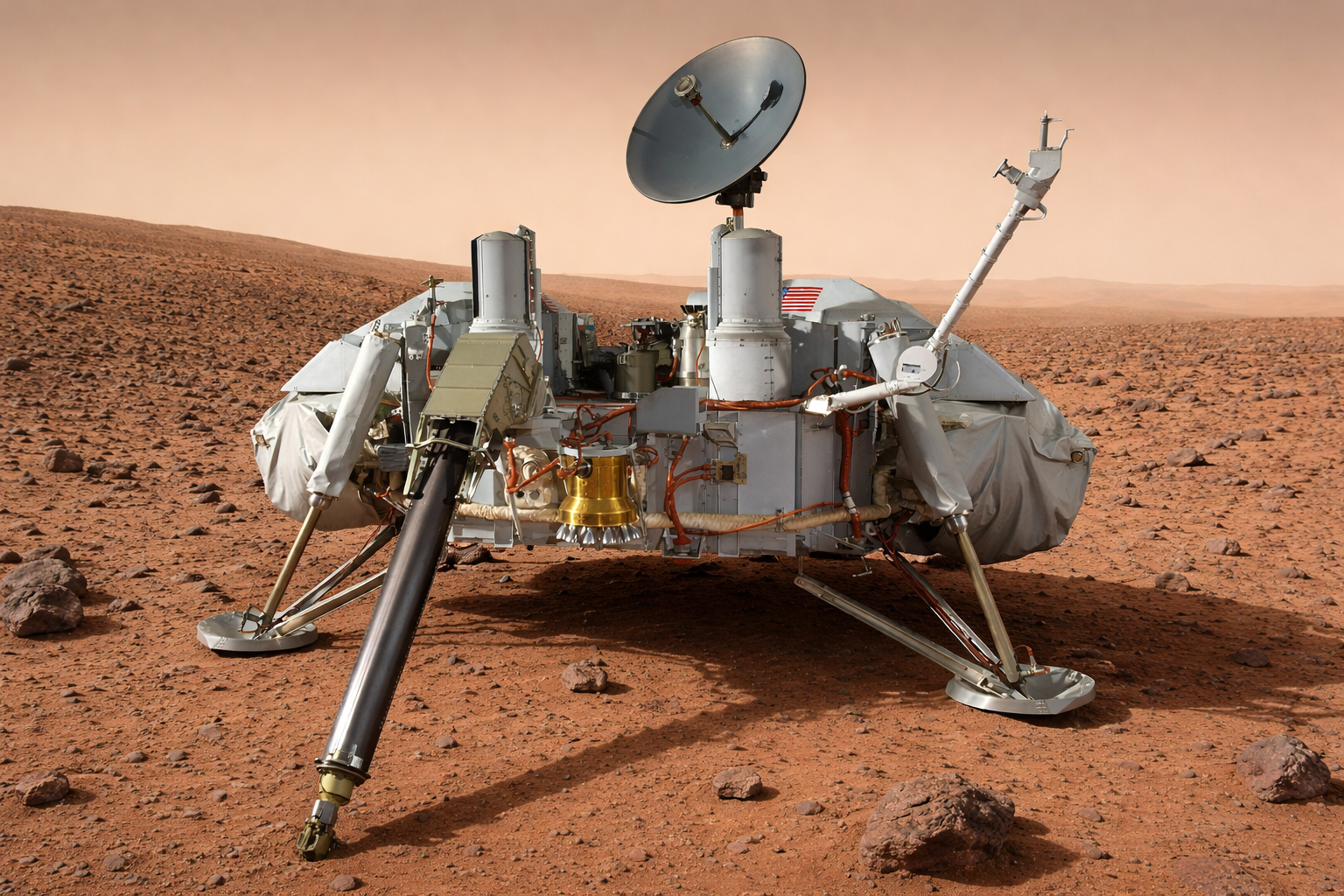
Most of the first information about the potential of Mars to support life on its near-surface came from experiments done in 1976 at two sites on the Martian surface visited by two sister Viking landers. Little of the primary data generated by these experiments survives as a cultural legacy in the community today. In particular, the community has only imperfectly integrated the Viking results, as they were actually observed, into information gathered since Mars exploration began anew in the 21st century, after a hiatus driven by the belief that Mars was an uninteresting, sterile planet (Fig. 1).
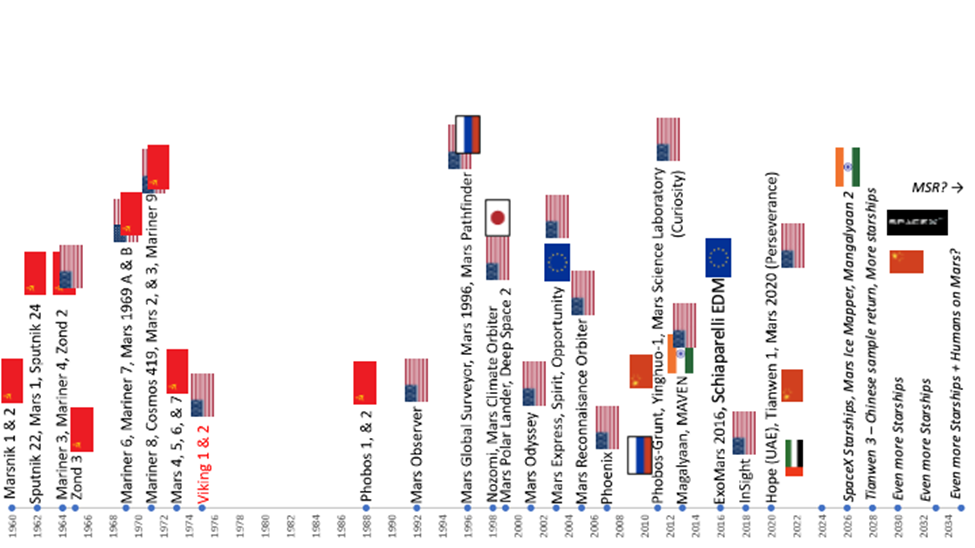
Figure 1. Mars missions. After misinterpreted data from a gas chromatograph-mass spectrometer (GC-MS) persuaded the community that the Martian near-surface soil contained no organic molecules in 1976, missions to Mars effectively stopped for two decades. This misinterpretation continues to adversely impact Mars exploration. Image used with permission from Jan Spacek.
That belief was driven largely by multiple misinterpretations of the Viking data coming from a gas chromatograph-mass spectrometer (GC-MS) instrument that returned data later in the mission, after results from the three life-detection experiments had arrived. Because the initially retrieved results were positive for life under the criteria for which the experiments were designed, the Viking data were immediately seen as life-affirming.
Robert Jastrow, then Director of NASA’s Goddard Institute for Space Studies, observed from the initial results that “short of seeing something wiggling on the end of a pin, the case for life on Mars is now as complete as the Viking experiments could make it.” (Chandler, 1977)
Writing in The Atlantic Magazine, science journalist David Chandler agreed. Viking’s “three brilliantly conceived experiments lead inevitably to one startling conclusion: Life, in some form, exists on Mars.” (Chandler, 1977).
That history is told in detail in an upcoming Penguin book, (Benner, 2026, Meet the Neighbors. Life on Mars and How to Find It) this summer. It offers a fascinating look into how real science is done by real scientists.
The Viking scientists themselves were, of course, operating in a “fog of war”. The real time development of the Viking interpretations reflected this.
However, even after a corrected interpretation of the misinterpretations in the Viking results became available in 2010 (Navarro-Gonzalez et al., 2010) to those who had an interest in Mars astrobiology, the larger culture continued to select missions, direct NASA’s Earth-based funding, and build plans for future biosignature analysis, based on the incorrect interpretations of Viking analysis. Even today, textbooks and Wikipedia pages get the facts wrong.
Therefore, my colleagues and I have begun a “take no prisoners” initiative to drive the community to fairly analyze what we actually know about the possibility of a Martian astrobiology. This began by getting a “retraction” e-letter posted to the 1976 paper in Science that began the cavalcade of confusion (Benner et al., 2025). We followed this month with a paper in Astrobiology (Benner et al., 2026).
Peer-reviewed literature is severely limited in the length and detail that can be presented. Accordingly, we now present a series of blog posts that takes advantage of the “open peer reviewing” format of Primordial Scoop to develop the entire story, long form. If you disagree with anything that I write, you have full access to the comments section to refute me. Please avoid profanity.
Today, we benefit from some excellent science that has been done by the operators of various NASA-funded landers and rovers (e.g. Hurowitz et al., 2025 and Pavlov et al., 2025). We will exploit this science, taking full advantage of hindsight that it offers, science that was not available in 1976.
The Single Scoops posted here will come in sets. The first in the set will explain, in layperson’s language, what the individuals who designed each Viking experiment intended their experiments to do, based on what they wrote in their own papers. We will analyze their design in terms of its strengths and weaknesses, including an emphasis on the potential of the design to generate false positives (signals that Martian life is present when it is in fact absent) and false negatives (signals that Martian life is absent, when it is in fact present).
A following Single Scoop will describe what actually happened on Mars. It starts with the observations as actually reported, largely without interpretation. It continues with an analysis of how the observations were interpreted in real time. It analyzes the anomalies observed, the paradoxes in their interpretations, and how the culture led those paradoxes being ignored or “explained away”.
The Scoop after that will discuss how we can reinterpret those interpretations in light of what we have learned since 1976. This will include the current state of the dialectic, the pro-and-con argumentation that is required for good science.
The final Scoop recognizes that Jan Spacek and his colleagues have reintroduced the concept of Mars penetrators into mission planning, this time in the form of a highly distributed rideshare system (International Mars Prospector Ride Share, IMPRESS). Since penetrators drop onto the surface with only minimal aerobraking, their costs related to the complexity of soft complex landers are avoided. Since multiple (even thousands) of penetrators can be sent via a single launch from Earth, the mission costs can be distributed across many participants, each costing a few tens of thousands of dollars to fly. This has the potential to democratize Mars exploration. I will offer concept designs for the first IMPRESS launch relevant to life detection.
For the “big-picture”, my goal is to move the community culture away from its consensus about Mars. At present, the view accepted by those who advise NASA on how it should distribute funds (but not by many others) is that the search for extant life on the near-surface of Mars is difficult and “risky” to the point of being futile. Scientists actually fear being labeled as “crackpots” if they make good faith arguments in this space.
In my opinion, this is not serving NASA well. And it has manifestly negative impact on Mars exploration. For example, the Visions and Voyages 2013-2022 Decadal Survey, prepared by the US National Academies for NASA, expressed this culture in this passage:
“Searching for evidence of extant life at Mars with a limited suite of experiments, with that constraint compounded by the uncertainty regarding the nature of possible martian life and issues of terrestrial contamination, would be difficult and carries very high scientific risk.”
To which one might say: “Yes, but this is why we hire scientists.”
Later documents reaffirm that the “acceptable” view of life detection is that it is extremely difficult, that no single experiment can “reach unique conclusion”, and that only aggregates of experiments can generate only probabilities.
If this set of Scoops is successful, it will move the culture back toward doing actual science, and advising NASA addressing the question arguably the most important to the taxpaying public: Is there life out there?
Yes, we are uncertain about the “nature of possible Martian life”. But we know much about life, the chemistry of life, and the chemistry of life in resource-sparse environments on Earth. We know much about Martian environments. We are intelligent enough to build models for metabolism that might support near-surface Martian life. These directly guide the design of experiments that might look for them, especially in an IMPRESS architecture (Spacek, 2024).
Further, synthetic biology has allowed us to explore, in Earth laboratories, alternative molecular systems capable of supporting Darwinian evolution. Darwinian evolution is likely to be the only process by which inanimate matter can self-organize to give the properties that we value in life. This synthetic biology work has identified biosignatures in the form of molecules that are required to support Darwinian evolution, rather than molecules that are (presumed) to be the products of Darwinian evolution. Among these, the Polyelectrolyte Theory of the Gene (PETOG) shows the possibility of using electrodialysis as part of an “agnostic life finding” instrument that can concentrate reliable biosignatures of extant life in water from very dilute samples (Spacek and Benner, 2022).
Last, we hope to mitigate the trend toward conformity that the culture imposes on discussion in this space. For this to happen, we must re-introduce the facts from Viking. And we must do so in a way that makes chemistry, the central science, understandable to geologists, astronomers, physicists, mathematicians, and engineers, who drive NASA funding and mission priorities.
References
Benner, S. A., Schulze-Makuch, D., Spacek, J., Abraham, C. A. (2025) The mistaken assignment in this paper of Martian methyl chloride as a “terrestrial contaminant” obstructed Mars exploration for a half century, continuing to today [eLetter]. Science https://www.science.org/doi/10.1126/science.194.4260.72#elettersSection
Benner, S. A., Schulze-Makuch, D., Spacek, J., Abraham, C. A. (2026) Viking Mars, now 50 years old, still needs a scientific analysis. Astrobiology doi:10.1177/15311074251404929
Carrier, B. L., Beaty, D. W., Meyer, M. A., Blank, J. G., Chou, L., Dassarma, S., des Marais, D. J., Eigenbrode, J. L., Grefenstette, N., Lanza, N. L., Schuerger, A. C., Schwendner, P., Smith, H. D., Stoker, C. R., Tarnas, J. D., Webster, K. D., Bakermans, C., Baxter, B. K., Bell, M. S., Benner, S. A., Bolivar Torres, H. H., Boston, P. J., Bruner, R., Clark, B. C., Dassarma, P., Engelhart, A. E., Gallegos, Z. E., Garvin, Z. K., Gasda, P. J., Green, J. H., Harris, R. L., Hoffman, M. E., Kieft, T., Koeppel, A. H. D., Lee, P. A., Li, X., Lynch, K. L., MacKelprang, R., Mahaffy, P. R., Matthies, L. H., Nellessen, M. A., Newsom, H. E., Northup, D. E., O’Connor, B. R. W., Perl, S. M., Quinn, R. C., Rowe, L. A., Sauterey, B., Schneegurt, M. A., Schulze-Makuch, D., Scuderi, L. A., Spilde, M. N., Stamenković, V., Torres Celis, J. A., Viola, D., Wade, B. D., Walker, C. J., Wiens, R. C., Williams, A. J., Williams, J. M., Xu, J. (2020) Mars Extant Life: What’s Next? Conference Report. Astrobiology 20, 785–814.
Chandler, D. (1977, February). Life on Mars. The Atlantic Monthly, 239(2), 18–24.
Hurowitz, J. A., Tice, M. M., Allwood, A. C., Cable, M. L., Hand, K. P., Murphy, A. E., … & Wolf, Z. U. (2025). Redox-driven mineral and organic associations in Jezero Crater, Mars. Nature, 645(8080), 332-340.
Navarro‐González, R., Vargas, E., de La Rosa, J., Raga, A. C., & McKay, C. P. (2010). Reanalysis of the Viking results suggests perchlorate and organics at midlatitudes on Mars. Journal of Geophysical Research: Planets, 115(E12).
Pavlov, A. A., Freissinet, C., Glavin, D. P., House, C. H., Stern, J. C., McAdam, A. C., … & Gomez, F. (2025). Does the Measured Abundance Suggest a Biological Origin for the Ancient Alkanes Preserved in a Martian Mudstone?. Astrobiology, 15311074261417879.
Spacek, J., Benner, S.A. (2022) Agnostic Life Finder (ALF) for large-scale screening of Martian life during in situ refueling. Astrobiology 22, 1255-1263. doi.org/10.1089/ast.2021.0070
Spacek, J. (2024)IMPRESS to Deliver Art and Science to Mars. Primordial Scoop, e20240920. https://doi.org/10.52400/PCFY7624
Posted with minor revisions by Jan Spacek 2/18/2026.
About the author
Steven Benner
Steven has developed the fields of paleogenetics, evolutionary bioinformatics, astrobiology and synthetic biology, working at Harvard, the ETH Zurich, and the University of Florida before establishing the Foundation for Applied Molecular Evolution (Alachua) and Firebird Biomolecular Sciences LLC.. His synthetic biology has had over $1.3 billion in medical applications, and is currently used in coronavirus detection. His laboratory has also resurrected 3 billion year old proteins in Jurassic Park experiments, and helped define how life may have arisen on Earth and Mars. Outside of science, Steven bicycled across the North American continent, 6083 kilometers in all. He earned a Bachelors and Masters Degrees in Molecular Biophysics and Biochemistry (Yale), and a Ph.D. in Chemistry (Harvard)
Originally posted on primordialscoop.org.