Published July 13, 2026 • Jan Spacek
Responding to NASA's RFI: A Commercial Path to Distributed Mars Astrobiology
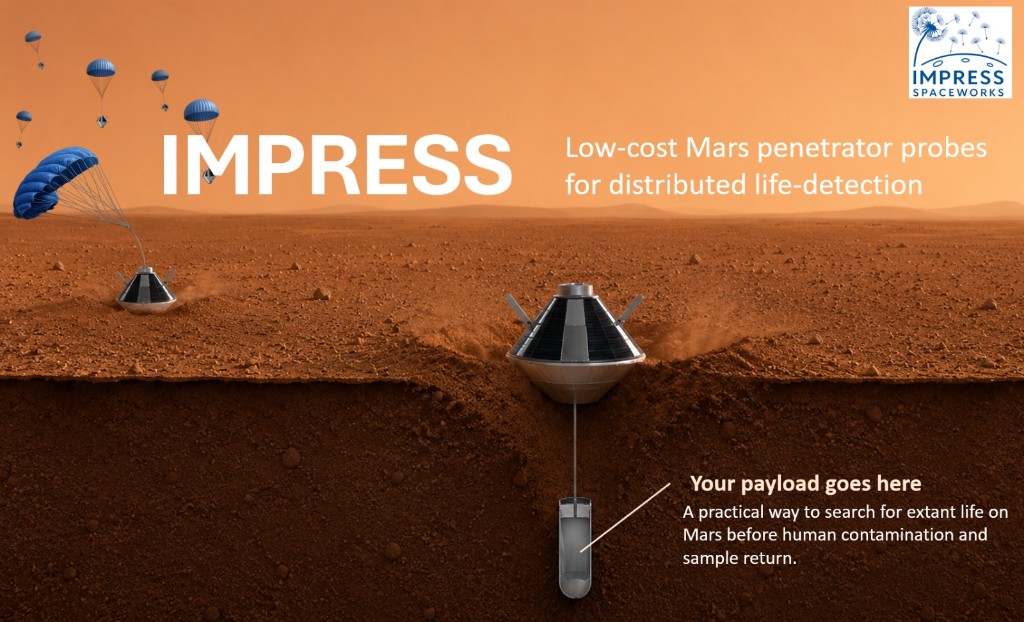
IMPRESS Spaceworks is developing a standardized commercial penetrator platform for distributed astrobiology, planetary protection, and prospecting on Mars. This post summarizes our response to NASA RFI NNH26ZDA010L.
Capability and relevant experience
IMPRESS Spaceworks Co. is developing a standardized commercial penetrator platform for distributed astrobiology, and prospecting on Mars.1 Its long-term purpose is to deploy hundreds to thousands of small instruments across multiple Martian environments, providing spatial coverage and replication beyond the reach of traditional landers, broadening access to direct Mars science in much the same way CubeSats broadened access to low Earth orbit.
This is especially important for the search for extant life. Potentially habitable environments on present-day Mars may be isolated, where ice, salts, favorable temperatures, redox gradients, transient water activity, and/or protection from radiation allow life to thrive in small enclaves. Thus, observations at a single landing site may have a limited value. Delivering multiple orthogonal life-detection experiments to many sites would increase the chance of detection and strengthen the interpretation of negative results.
The time available to establish an uncontaminated biological baseline is limited. China’s Tianwen-3 mission plans to return Martian samples around 2031.2 If extant life is present on the Martian surface, it may be announced by the Chinese scientists, challenging NASA’s leadership.
A second constraint is the prospect of crewed missions. These would introduce a large terrestrial bioburden, complicating the life-search. Additionally, while the search for life was identified as the highest science priority for crewed exploration,3 from the backward planetary protection perspective, if the astronauts find active Mars life, no decontamination protocol exists, and thus their return could be threatened by concerns of protecting Earth from possible biohazards. Known environmental microorganisms typically outlive astronauts in a quarantine, and if compatible, Mars life may influence Earth’s biosphere through horizontal gene transfer even if the cells are inactivated.
IMPRESS addresses the issue of extant life by distributing many relatively simple probes. Each probe uses its descent kinetic energy to emplace a forebody approximately 0.2–1 meter into the regolith. Impact velocity, and therefore expected penetration depth, can be adjusted in part through parachute sizing. A tethered aftbody may remain at the surface for power, communications, and surface measurements. Standardized interfaces would let independent teams develop instruments without building a complete Mars landing system.1
The reference architecture described in Spacek et al. 2026 illustrates the possible scale. Four entry capsules, each carrying 1,500 approximately 2 kg penetrators, would deploy 6,000 probes from one dedicated Mars launch. The preliminary cost model in Spacek et al. (2026) illustrates how standardization and mass production could make measurements at thousands of sites possible.
The principal application would be a broad survey for extant life. Other payloads within the distributed network could measure habitability, geochemistry, shallow ice, thermal properties, seismic activity, meteorology, radiation, and regolith properties. Distributed results would help select sites for larger astrobiology landers, provide context to astrobiology results, and characterize locations for later operations.
Current hardware development builds on the IMPRESS-345 platform developed by Guinn Partners under NASA’s TechLeap Prize.4 The field platform includes a penetrator forebody, detachable aftbody, battery, telemetry, UHF communications, high-g accelerometry, thermal sensing, and an instrument power interface. IMPRESS Spaceworks has also submitted a NASA SBIR Phase I proposal addressing platform requirements, payload interfaces, instrument accommodation, impact-test architecture, and system feasibility, with Stone Aerospace as a subcontractor and technical advisor. Early, nonbinding discussions have considered an antibody-array instrument associated with Víctor Parro’s research, a successor to Levin’s Chiral Labeled Release experiment, and cultivation experiments in collaboration with the private biotechnology sector.
Development route and SkyFall pathfinder
IMPRESS intends to advance through progressively larger deployments: terrestrial qualification; a Mars pathfinder involving several probes; rideshare missions involving tens to hundreds; and a dedicated survey involving thousands of probes. Each stage would provide useful measurements and guide the next steps.
NASA’s SkyFall mission is a possible host for the first Mars pathfinder. IMPRESS Spaceworks proposes that NASA and JPL evaluate a minimum secondary payload of three probes, representing ~10 kg of probe mass. Host-specific retention and release hardware would be defined during an accommodation study.
The probes would be released along the 4 helicopters from the descending Mars entry capsule. They would operate independently after release. A baseline package could measure atmospheric conditions during descent, probe orientation, surface and subsurface temperature, post-impact health, and local regolith mechanical properties inferred from impact deceleration profiles. These measurements could complement the helicopters’ observations and provide the first Mars flight test of a standardized distributed penetrator platform. A feasible package will also include Chiral Label Release experiment or other simple life-finding experiments.
Three probes would not constitute a comprehensive search for Martian life. Their purpose would be to demonstrate deployment, passive stabilization, impact survival, shallow emplacement, communications, contamination control, and operation as a distributed set. Later missions could carry more capable astrobiology payloads in numbers sufficient to address spatial variability.
Deep Space 2 provides precedent for rapid Mars microprobe development: the project progressed from early testing in 1995 to launch in January 1999. Although the probes failed to return data, the program showed that compact penetrators could be developed and integrated with a host Mars mission on roughly a three-year schedule.5
A SkyFall opportunity would require an early accommodation decision and a tightly controlled baseline design. If SkyFall cannot accept the probes because of schedule, deployment, or risk constraints, the same pathfinder package could be prepared for another government or commercial Mars mission before CNSA’s sample return, such as the proposed upcoming Mars Telecommunications Network.
Following a successful pathfinder, rideshare missions could carry tens to hundreds of probes for regional ice, habitability, contamination, and landing-site surveys. A later dedicated mission could deploy thousands of instruments across several regions with replicated, complementary life-detection experiments.
Potential collaboration and mutual benefit
IMPRESS Spaceworks seeks NASA collaboration in four connected areas.
1) NASA, JPL, and IMPRESS Spaceworks could conduct a rapid accommodation study for several probes on SkyFall or determine whether an independent low-mass IMPRESS entry capsule could use the science-payload accommodation requested for NASA’s planned Mars Telecommunications Network mission.6 The study would define mass, volume, release conditions, separation, landing dispersion, communications, environmental and planetary-protection requirements, qualification testing, schedule, and responsibilities. Its result would be a go/no-go accommodation decision and a preliminary interface definition.
2) NASA and IMPRESS Spaceworks could establish a funded or nonreimbursable Space Act Agreement for platform maturation, including Mars environmental requirements, standardized payload interfaces, impact qualification, contamination-control procedures, sterilization compatibility, and integration of representative instruments.
3) NASA could support solicitations for compact astrobiology or other instruments designed for penetrator delivery. Instrument teams could develop experiments against a common platform and qualification environment, producing multiple low-cost, orthogonal approaches to searching for and studying life on Mars.
4) NASA could include IMPRESS in planning for commercial Mars transportation, relay, hosted-payload, and surface-delivery services. IMPRESS Spaceworks intends to serve NASA alongside scientific, commercial, philanthropic, and international customers.
Through this collaboration, NASA would gain a new low-cost method for obtaining replicated surface and shallow-subsurface measurements before committing to larger mission landing sites. IMPRESS Spaceworks would gain authoritative requirements, planetary-protection guidance, mission-integration experience, instrument partners, and a route toward NASA procurement of distributed Mars measurements.
The immediate requested outcome is discussion with NASA Astrobiology, the Office of Planetary Protection, the Mars Exploration Program, the SkyFall project, and relevant commercial-services personnel. The larger objective is to progress from several Mars probes, to regional networks, and ultimately to a survey large enough to search Mars for a sparse and unevenly distributed biological target before later activities make that search more difficult.
References
1 Spacek, J. et al. IMPRESS: A Planetary Penetrator Network for Astrobiology, Prospecting, and Exploration of Mars. Astrobiology in press. Preprint available at https://impressmars.com/blog/impress-a-planetary-penetrator-network-for-astrobiology-prospecting-and-exploration-of-mars-preprint/ (2026).
2 Hou, Z. et al. In search of signs of life on Mars with China’s sample return mission Tianwen-3. Nature Astronomy 9, 783-792 (2025).
3 NASEM. A Science Strategy for the Human Exploration of Mars. (Washington, 2026).
4 nasa.gov. TechLeap project: IMPRESS: Iterative Mars Penetrator for Subsurface Science, https://techport.nasa.gov/projects/184149 (2026).
5 Smrekar, S. et al. Deep Space 2: the Mars microprobe mission. Journal of Geophysical Research: Planets 104, 27013-27030 (1999).
6 Low, L. E. NASA Draws on Industry for Mars Telecommunications Network, https://www.nasa.gov/directorates/esdmd/nasa-draws-on-industry-for-mars-telecommunications-network/ (2026).
About the author
Jan Spacek
Jan has worked in the field of electrochemistry of modified and natural DNA at the Czech Academy of Sciences and the Central European Institute of Technology. He has also visited the Ege University (Izmir), the Interdisciplinary Nanoscience Center (Aarhus), the Department of NanoEngineering at UCSD, and the Foundation for Applied Molecular Evolution (Alachua). He presently develops life detection devices, from coronavirus to Venusians and Martians, at the Firebird Biomolecular Sciences LLC. Outside of science, Jan bicycled around the Baltic Sea and across the Australian continent, 7500 kilometers in all. Jan earned a Master’s degree in Molecular Biology and Genetics and a Ph.D. in Genomics and Proteomics (both at Masaryk University in the Czech Republic).